
Xander Fischer · 10 November 2026
Resource Allocation Tactics in Niche Federated Microblogging Setups
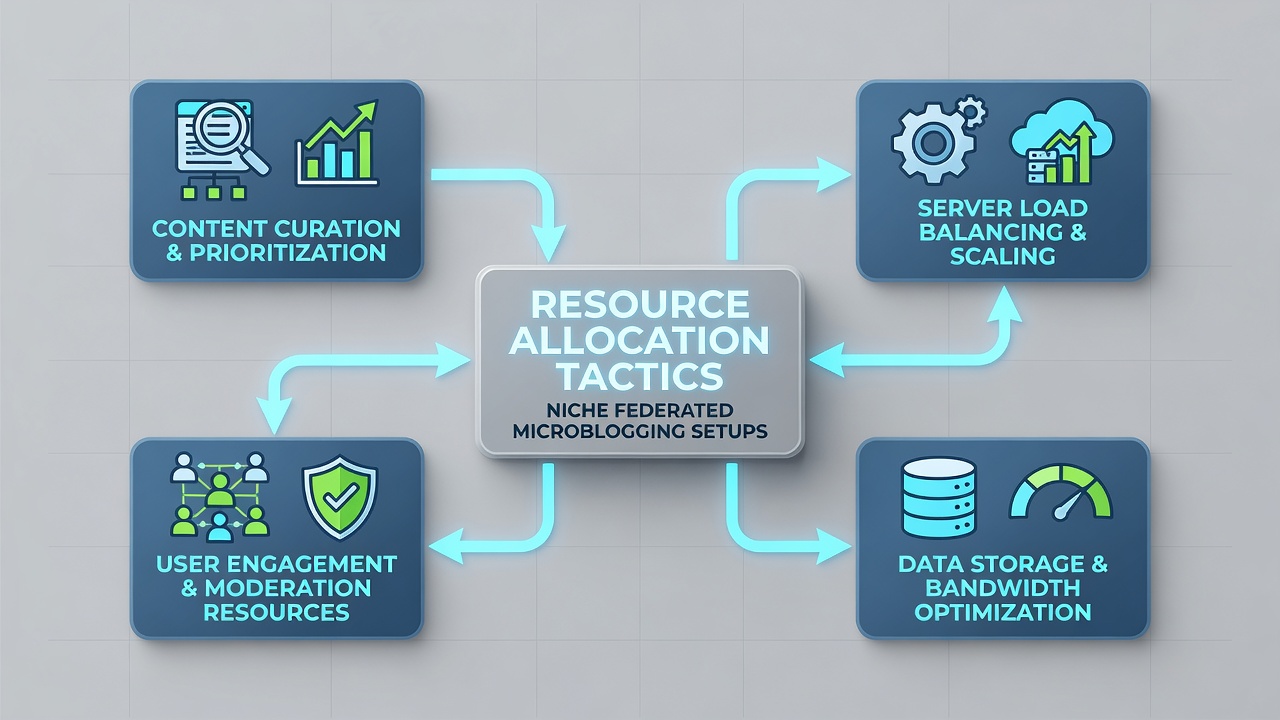
Administrators of niche federated microblogging setups manage limited server resources while supporting local communities and maintaining connections across the wider ActivityPub network, and these setups typically operate on volunteer hardware with constrained budgets that force precise decisions about CPU cycles, memory pools, disk space and outbound bandwidth. Data from multiple small-scale deployments shows that incoming federation traffic often accounts for the largest share of bandwidth usage, which leads operators to implement selective caching rules that store only media from trusted peers rather than every remote post.
Core Resource Categories in Small-Scale Instances
Observers note that storage allocation receives the most attention in these environments because media attachments and user-uploaded files accumulate quickly, whereas CPU and RAM demands spike during peak federation sync periods when instances exchange activity streams with dozens of remote servers. Studies conducted by university research groups indicate that instances serving under 500 active users commonly allocate 60 percent of available disk capacity to local content and reserve the remainder for temporary federation caches that expire after set intervals.
Network throughput follows a different pattern because outbound requests to other instances compete with user-initiated activity, and administrators frequently configure rate limits on federation workers to prevent single remote servers from consuming disproportionate bandwidth during high-traffic events. Figures released in November 2026 from the European Commission digital infrastructure monitoring program revealed that decentralized platforms experienced a 22 percent rise in cross-instance media transfers compared with the previous year, prompting many operators to adopt compression pipelines before files leave the local node.
Practical Allocation Methods Observed Across Deployments
Those who maintain niche instances apply several repeatable tactics that balance responsiveness for local users against the demands of federation. One common approach involves prioritizing database queries from authenticated local accounts while deferring background tasks such as remote profile updates until off-peak hours, which reduces contention on shared CPU resources. Another method uses tiered storage where frequently accessed posts remain on fast SSD volumes and older content migrates to slower archival drives after a defined retention window.
Load monitoring scripts track real-time metrics for memory usage and connection counts, allowing operators to adjust worker thread counts dynamically without restarting services. Research published by academic teams at institutions in Canada and Australia demonstrates that instances employing automated scaling scripts for federation workers reduced average response latency by measurable margins during synchronized update events across the network.
Monitoring and Adjustment Practices
Continuous observation of resource consumption patterns enables administrators to refine allocation rules over successive weeks rather than reacting to sudden spikes. Tools that aggregate logs from web servers, database engines and federation daemons provide the raw data needed to identify which remote domains generate the heaviest traffic, after which operators can decide whether to increase cache retention for those domains or impose stricter connection limits. Reports compiled by trade organizations focused on open-source infrastructure note that instances maintaining detailed per-domain traffic profiles achieve more stable performance during periods of elevated network activity.
Budget constraints also shape hardware choices, and many volunteer teams select commodity servers with expandable RAM slots so memory upgrades can occur incrementally as user numbers grow. This modular approach avoids over-provisioning at the outset while preserving headroom for unexpected federation surges that occur when popular remote posts draw attention to the local community.
Conclusion
Resource allocation in niche federated microblogging setups centers on measured distribution of storage, compute and network capacity according to documented usage patterns rather than uniform default settings. Operators who track per-domain traffic, apply selective caching, and schedule non-urgent federation tasks during low-demand windows maintain stable service levels even when hardware remains modest. Data gathered through 2026 continues to guide incremental refinements that keep these decentralized communities operational without requiring enterprise-scale infrastructure.